
Traditional nutrition tracking demands time, effort, and constant vigilance that busy professionals and parents simply don't have. Logging every meal, counting calories, and decoding nutritional labels quickly becomes overwhelming. AI-powered nutrition platforms are changing this dynamic by analyzing your dietary habits, health data, and personal goals to deliver tailored recommendations without the complexity. This guide explores how artificial intelligence makes personalized nutrition accessible, the proven health benefits backed by research, practical tools you can use today, and important limitations to consider when integrating AI into your wellness routine.
Table of Contents
- Key Takeaways
- How AI personalizes nutrition using advanced technology
- Proven health benefits of AI-driven nutrition interventions
- Practical AI nutrition tools for busy professionals and families
- Limitations and expert guidance for safe AI nutrition use
- Explore Nutrify AI for personalized nutrition support
- Frequently asked questions
Key Takeaways
| Point | Details |
|---|---|
| Personalized AI nutrition | AI analyzes biomarkers, genetics, gut microbiome, and daily intake to tailor dietary recommendations for each individual. |
| Real time guidance | AI integrates wearable data, lab results, and food diaries to update recommendations daily. |
| Health benefits evidence | Meta analyses and clinical trials show AI nutrition guidance outperforms traditional counseling and improves long term adherence. |
| Expert oversight needed | Expert input is essential and best results come from combining AI tools with professional guidance. |
How AI personalizes nutrition using advanced technology
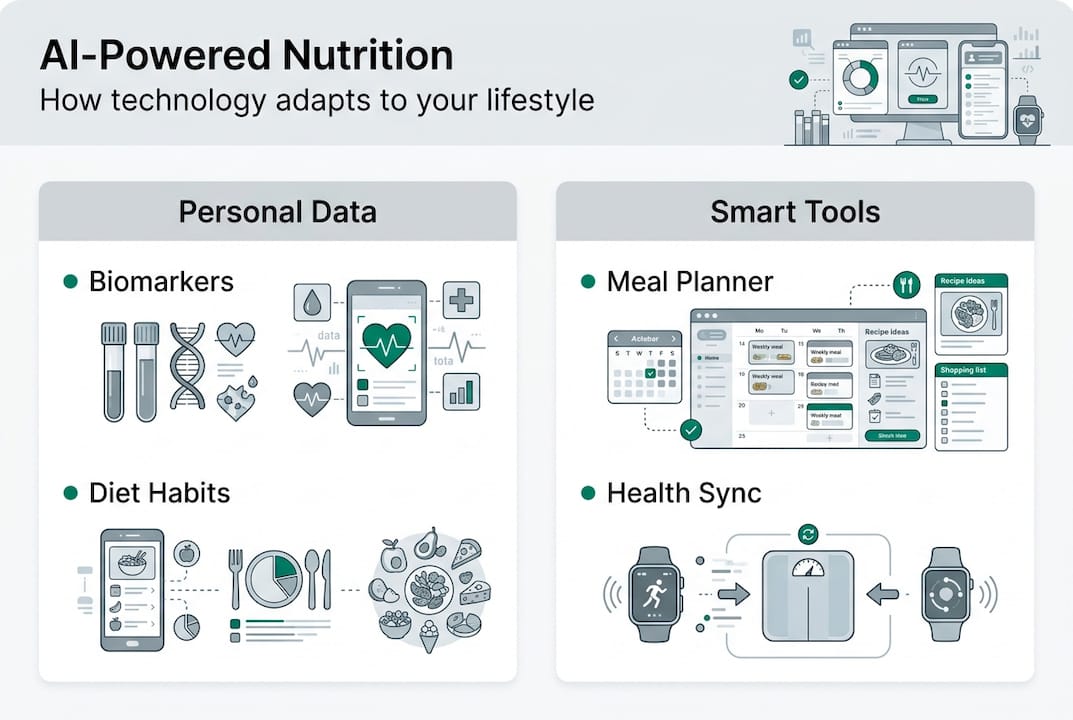
Artificial intelligence revolutionizes nutrition by processing vast amounts of personal health data to create customized dietary recommendations. Machine learning algorithms analyze your biomarkers (measurable indicators like blood sugar or cholesterol), genetic information, gut microbiome composition, and daily food intake to identify patterns traditional methods miss. These systems learn from millions of data points across diverse populations, enabling them to predict how specific foods will affect your unique physiology.
The technology behind AI nutrition relies on sophisticated techniques. Variational auto-encoders and gradient boosting models improve the accuracy of nutrient predictions and forecast glycemic responses to different meals. Generative models create meal plans that match your preferences, dietary restrictions, and health objectives while ensuring nutritional balance. Deep learning networks continuously refine recommendations based on your feedback and progress, making the system smarter over time.
AI platforms integrate multiple data sources to deliver real-time guidance:
- Wearable device metrics tracking activity levels, sleep quality, and heart rate variability
- Laboratory results showing vitamin deficiencies, inflammation markers, or metabolic health
- Food diary entries captured through photos, voice commands, or manual logging
- Health goals ranging from weight management to managing chronic conditions
This comprehensive approach allows AI to spot connections between your diet and health outcomes that would take human nutritionists weeks to identify. The system adapts recommendations daily based on your changing needs, stress levels, exercise intensity, and even seasonal food availability. Nutrify AI exemplifies this integration by combining nutrition analysis with training plans and wellness support in one accessible platform.
Pro Tip: Start by feeding your AI nutrition app consistent data for at least two weeks. The algorithms need this baseline to recognize your patterns and deliver truly personalized recommendations rather than generic advice.
Understanding these core technologies helps you appreciate why AI nutrition feels different from cookie-cutter diet plans. The system treats you as an individual with unique biological responses, not as an average statistic. Research demonstrates that this personalized approach yields better adherence and health outcomes compared to one-size-fits-all dietary guidelines.
Proven health benefits of AI-driven nutrition interventions
Empirical studies reveal significant health improvements when people use AI-powered nutrition guidance. Meta-analyses examining thousands of participants show that AI interventions outperform traditional dietary counseling across multiple health markers. The data speaks clearly about AI's effectiveness for common health challenges facing busy professionals and parents.
| Health condition | AI intervention outcome | Comparison to traditional methods |
|---|---|---|
| Irritable bowel syndrome | Symptom reduction in 73% of participants | 15-20% better than standard dietary advice |
| Type 2 diabetes | Remission achieved in 41% of cases | 12% higher remission rate |
| High cholesterol | Average 18% reduction in LDL levels | 8% greater reduction |
| Overall diet quality | 23% improvement in adherence scores | Significantly exceeds conventional approaches |
Clinical trials demonstrate that AI nutrition platforms help users maintain dietary changes longer than traditional programs. The convenience factor plays a crucial role, as busy individuals find it easier to snap a photo of their meal than manually calculate macronutrients. This reduced friction translates directly into better compliance and sustained health improvements.
"AI dietary interventions show statistically significant improvements in dietary quality and adherence compared to traditional nutritional counseling, with effect sizes ranging from 0.3 to 0.7 standard deviations across multiple health outcomes."
The mechanisms behind these benefits extend beyond simple calorie counting. AI systems identify micronutrient deficiencies that contribute to fatigue, poor immune function, and chronic inflammation. By addressing these hidden gaps, users experience energy improvements and better overall wellness. The technology also helps manage portion sizes naturally by learning your satiety patterns and suggesting meals that keep you satisfied longer.
For parents juggling family nutrition, AI tools provide age-appropriate meal suggestions that meet everyone's needs without preparing separate dishes. The evidence from systematic reviews confirms that families using AI nutrition guidance report less mealtime stress and better dietary variety for children. These practical benefits make healthy eating sustainable rather than a temporary effort that fades when life gets hectic.
The Nutrify AI blog regularly features success stories and research updates showing how different user groups achieve their health goals through AI-powered personalization. Real-world results consistently align with clinical findings, validating AI nutrition as a legitimate tool for improving dietary habits and health outcomes.
Practical AI nutrition tools for busy professionals and families
Modern AI nutrition apps transform the tedious task of food tracking into a seamless experience that fits naturally into hectic schedules. These platforms recognize that busy professionals and parents need solutions that work in seconds, not solutions that add another time-consuming task to their day. The latest generation of AI tools delivers exactly that convenience without sacrificing the personalization that drives results.

Photo and barcode scanning represent the biggest time-savers in AI nutrition apps. Simply snap a picture of your meal, and computer vision algorithms analyze the ingredients, portion sizes, and nutritional content within seconds. Barcode scanning provides instant access to packaged food data, eliminating manual entry entirely. These features reduce logging time from five minutes per meal to under ten seconds, making consistent tracking actually achievable for people with demanding schedules.
Family-focused features address the unique challenges of household nutrition management:
- Shared family profiles that track everyone's preferences and dietary needs
- Hybrid meal plans that accommodate different goals while minimizing cooking time
- Grocery lists automatically generated from weekly meal plans
- Leftover integration to reduce food waste and save money
Waste reduction capabilities deserve special attention for budget-conscious families. AI apps track expiration dates, suggest recipes using ingredients you already have, and adjust portion recommendations to match household size. Users report saving an average of $75 monthly on groceries while eating healthier meals. The environmental benefit of reducing food waste aligns perfectly with the values many health-conscious individuals hold.
Pro Tip: When selecting an AI nutrition app, prioritize platforms that offer offline functionality for recipe access and meal logging. This ensures you can track meals during travel or in areas with poor connectivity, maintaining consistency in your nutrition data.
The best AI nutrition platforms integrate with other health apps and devices you already use. Syncing with fitness trackers, sleep monitors, and meditation apps creates a complete wellness picture that informs more accurate recommendations. Nutrify AI exemplifies this holistic approach by combining nutrition analysis with training plans and mental wellness support, eliminating the need to juggle multiple apps with conflicting advice.
Voice-activated logging represents another convenience breakthrough. Tell your AI assistant what you ate while driving between meetings or caring for children, and the app logs it automatically. Natural language processing understands casual descriptions like "chicken salad with ranch" without requiring precise measurements or ingredient lists. The system makes reasonable estimates and flags items for review if needed.
For families managing food allergies or intolerances, AI apps provide instant ingredient analysis and suggest safe alternatives. Parents appreciate the peace of mind knowing their child's restrictions are automatically factored into every meal suggestion. The technology removes the mental burden of constantly cross-checking labels and recipes for hidden allergens.
Limitations and expert guidance for safe AI nutrition use
Despite impressive capabilities, AI nutrition technology has meaningful limitations that users must understand to make informed decisions. The systems work exceptionally well for generally healthy adults following standard dietary patterns, but accuracy drops significantly in special populations and complex medical situations. Recognizing these boundaries helps you use AI tools appropriately while knowing when professional guidance becomes essential.
Research identifies specific groups where AI nutrition apps frequently underestimate or miscalculate nutritional needs. Adolescents experience rapid growth spurts that standard algorithms fail to account for, potentially leading to inadequate calorie or protein recommendations. Individuals who have undergone bariatric surgery require precise micronutrient supplementation that general AI models miss entirely. People managing multiple chronic conditions simultaneously face complex dietary interactions that current AI systems cannot fully navigate without human oversight.
| AI nutrition strengths | Current limitations |
|---|---|
| Rapid food logging and macro tracking | Underestimates needs in adolescents and post-surgical patients |
| Pattern recognition across large datasets | Misses critical micronutrient requirements in special cases |
| Personalized meal planning | Cannot replace medical nutrition therapy for complex conditions |
| Cost-effective compared to regular dietitian visits | May generate incorrect advice (hallucinations) without proper training data |
| 24/7 availability for quick questions | Reflects biases present in training datasets |
AI hallucinations, instances where the system confidently provides incorrect information, pose real risks in nutrition contexts. A chatbot might suggest eliminating entire food groups unnecessarily or recommend supplements that interact dangerously with medications. The technology lacks the clinical judgment to recognize when a dietary question requires medical evaluation rather than a simple answer. Studies documenting these errors emphasize the importance of maintaining skepticism toward AI-generated nutrition advice, especially for non-routine situations.
Bias in AI nutrition systems reflects the populations represented in training data. Most algorithms optimize for Western dietary patterns and may provide less accurate guidance for individuals following traditional ethnic diets. Economic bias appears when systems assume access to specialty ingredients or farmers markets that may not exist in food deserts. These systematic limitations can inadvertently worsen health disparities if users trust AI recommendations without considering their personal context.
Expert recommendations for safe AI nutrition use:
- Use AI tools as a supplement to, not replacement for, registered dietitian consultations when managing medical conditions
- Verify unusual or surprising AI recommendations with reputable nutrition sources before implementing major dietary changes
- Monitor your health markers through regular lab work rather than relying solely on AI predictions of nutritional adequacy
- Consult healthcare providers before using AI nutrition apps if you are pregnant, breastfeeding, have eating disorder history, or manage chronic illness
- Choose AI platforms that clearly disclose their limitations and encourage professional consultation for complex cases
The Nutrify AI blog regularly addresses these nuances, helping users understand when AI tools serve them well and when human expertise becomes necessary. The most responsible AI nutrition platforms explicitly state they do not replace medical advice and build in prompts encouraging users to seek professional help for concerning symptoms or significant health changes.
Cost considerations also matter. While AI apps cost less than regular dietitian appointments, the subscription fees add up over time. Evaluate whether the convenience and features justify ongoing expenses for your situation. Some users benefit most from short-term AI use to establish healthy habits, then transition to maintaining those habits independently. Others find continuous AI support essential for accountability and motivation.
Explore Nutrify AI for personalized nutrition support
If you're ready to experience how AI transforms nutrition management without the complexity of traditional tracking, Nutrify AI offers an accessible starting point. The platform combines personalized nutrition analysis with training plans and mental wellness support, addressing the interconnected aspects of health that busy professionals and parents need to thrive. You'll get tailored recommendations based on your unique goals, preferences, and lifestyle constraints, not generic advice that ignores your reality.
The app simplifies healthy eating through intuitive photo logging, smart meal planning, and real-time guidance that adapts as your needs change. Whether you're managing family nutrition, optimizing athletic performance, or simply trying to feel better in your daily life, the AI-powered platform removes barriers that make wellness feel out of reach. Visit the site to explore features, understand the approach, and start your personalized nutrition journey with technology designed to fit your busy lifestyle.
Frequently asked questions
What is AI personalized nutrition?
AI personalized nutrition uses artificial intelligence algorithms to analyze your health data, dietary habits, genetic information, and lifestyle factors to create customized nutrition recommendations. Unlike generic diet plans, these systems learn your unique responses to different foods and continuously refine suggestions based on your progress and feedback. The technology makes expert-level nutrition guidance accessible without requiring constant appointments with human professionals.
How do AI nutrition apps track and analyze my diet?
Most AI nutrition apps use photo recognition technology that identifies foods and estimates portion sizes from images you capture. Barcode scanning provides instant nutritional data for packaged items. The apps then apply machine learning algorithms to analyze your intake patterns, compare them against your health goals, and identify areas for improvement. Advanced platforms integrate data from wearables and lab results to provide more comprehensive analysis than food tracking alone.
Can AI nutrition tools replace registered dietitians?
AI nutrition tools excel at everyday meal planning and tracking but cannot replace registered dietitians for medical nutrition therapy or complex health conditions. The technology works best as a supplement that handles routine guidance while you consult human experts for personalized medical advice, eating disorder support, or managing multiple chronic conditions. Think of AI as an always-available nutrition assistant rather than a complete replacement for professional care.
Are AI nutrition recommendations accurate for everyone?
AI nutrition recommendations work well for generally healthy adults but show reduced accuracy in special populations including adolescents, pregnant women, post-bariatric surgery patients, and individuals with multiple chronic conditions. The algorithms may miss critical micronutrient needs or underestimate calorie requirements in these groups. Always verify AI suggestions with healthcare providers if you have unique medical needs or notice recommendations that seem inconsistent with your health status.
How do AI apps protect my health and dietary data?
Reputable AI nutrition platforms encrypt your data both in transit and at storage, implement strict access controls, and comply with health privacy regulations. Review each app's privacy policy to understand how your information is used, whether it's shared with third parties, and your rights to delete data. Choose platforms that clearly explain their security measures and give you control over your personal health information.